Why Most Remote Jobs Don't Last and What We Do Differently

Building Careers Instead of Chasing Gigs

Remote work has transformed how we build careers. Genuinely transformed it. 

I still remember, must’ve been 2020 or so, when people thought working from home meant the end of “real work.” Now? Professionals are connecting with organizations across continents, building meaningful contributions from their kitchens, coffee shops, bedrooms. It’s remarkable, honestly. The barrier to entry used to feel insurmountable. A stable internet connection, the right skills, willingness to learn then suddenly those three things opened doors that seemed permanently locked. 

Yet here’s what I keep hearing from remote professionals everywhere: 

The job didn’t last. 

And it guts me a little each time. Because it shouldn’t be this way. 

A client vanished without explanation. A contract ended with no warning, no feedback, just… gone. Communication dried up. Suddenly you’re left wondering if you failed, or if the entire arrangement was fundamentally broken from the start. Expectations? Vague at best. Growth opportunities? They were always just… around the corner. Eventually, what started as this thrilling opportunity, this break from the traditional office grind became another forgettable gig. Another resume line. Another “well, it wasn’t a good fit.” 

At My Sahay Global, we’ve spent four years working with remote professionals and supporting organizations across wildly different industries. Healthcare, tech, finance, creative sectors… the industry changes, but the pattern? It repeats itself relentlessly. 

And we’ve discovered something that might sound obvious when you say it out loud, but it’s revolutionary in practice: 

Most remote jobs fail for reasons that have absolutely nothing to do with talent. 

Why Many Remote Jobs Don't Last

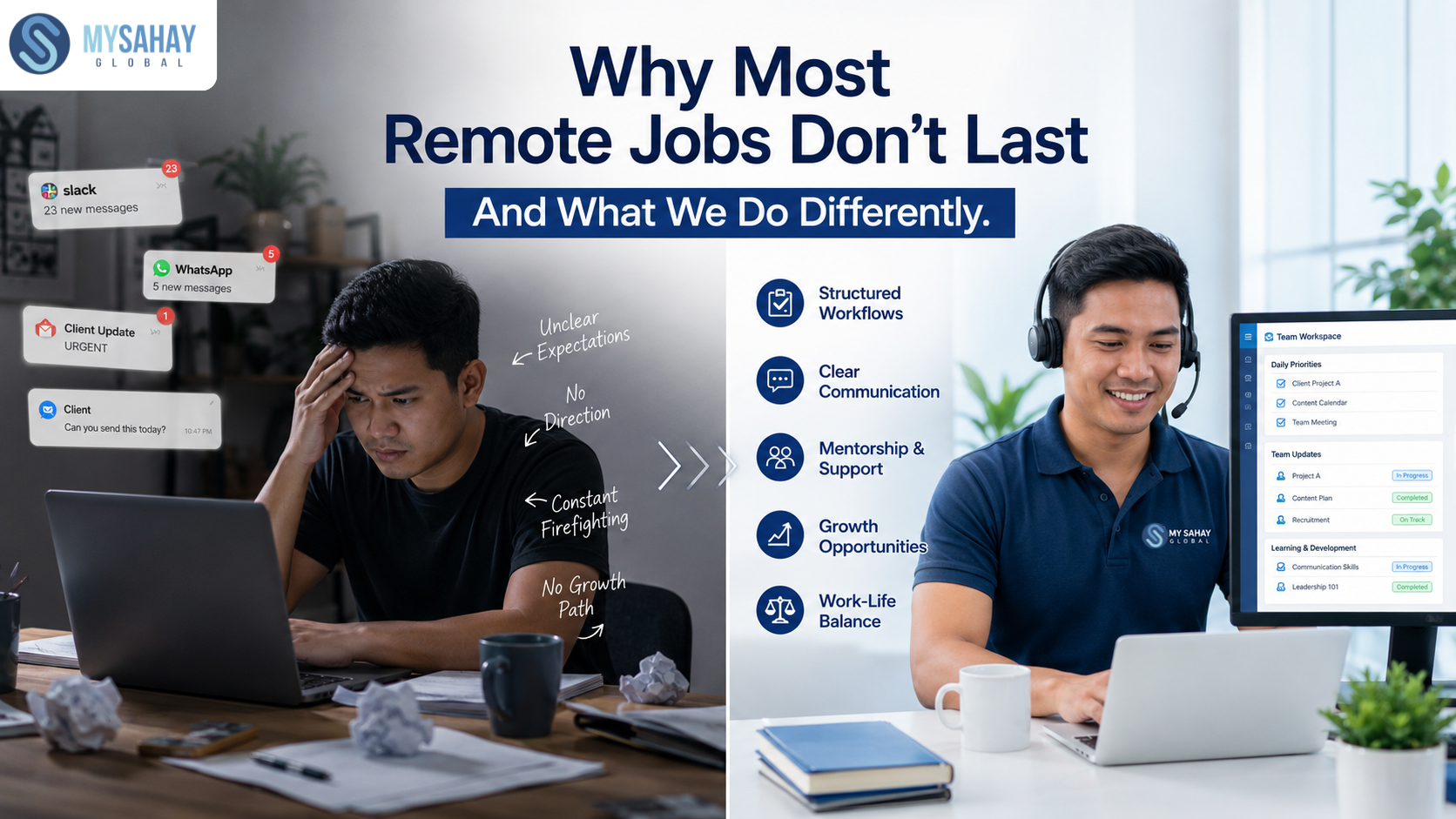
Lack of Clear Expectations

(And Why Nobody Talks About It)

One of the biggest or maybe the biggest challenge in remote work is this creeping, persistent uncertainty. 

You start a role. You’re enthusiastic. You’re ready. But then… nobody’s really told you what success looks like. Not clearly, anyway. Not in those concrete, measurable terms that make your brain feel settled. 

Professionals begin without a true understanding of: 

  • What responsibilities actually fall on your shoulders versus someone else’s 
  • How performance will be measured (is it output? Hours logged? Relationships built?) 
  • What communication looks like daily? Weekly? Only when there’s a problem? 
  • Whether growth happens naturally, or if you have to fight for it 

When expectations remain fuzzy, misunderstandings don’t just happen—they proliferate. A small issue here, a misalignment there, and suddenly you’re navigating a minefield. Strong remote careers (the ones that actually las) require clarity. They demand it, actually. From day one.

Poor Communication Systems

(The Silent Career Killer)

Here’s something I’ve noticed: remote work lives and dies by communication. 

Not talent. Not effort. Communication. 

When communication becomes inconsistent, when responses take days, when messages get lost in Slack or MS Teams threads, when no one’s really sure who to ask or when, trust corrodes. Quietly at first. Then all at once. You start checking your messages obsessively. You re-read emails looking for hidden meanings. You wonder if you’re being too pushy or not pushy enough. 

Many remote opportunities fail because there’s no system for healthy communication. No structure. Just hope that things will somehow work themselves out. (Spoiler: they don’t.) 

The frustration? It builds on both sides. The organization wonders why the remote worker seems disengaged. The professional wonders if anyone actually values their work. 

Focus on Tasks Instead of Development

This one’s tricky, because it’s not always intentional. 

Companies hire remote workers to solve a problem. An immediate problem. A gap that needs filling. There’s urgency, there’s need, there’s justification. What there isn’t, often, is investment in you. 

Professionals become task executors. Order-takers. You’re good at your job, sure—maybe excellent—but you’re a function. A means to an end. Without opportunities to grow, to learn new skills, to take on bigger challenges? Engagement doesn’t just decline it evaporates. People leave. New people arrive. The cycle repeats.

No Support Structure

(Loneliness Disguised as Freedom)

Remote work can be isolating. I’ll be honest about that. 

You navigate challenges alone. You troubleshoot. You figure things out. Sometimes that’s empowering. Often, though, it just feels… lonely. Questions go unanswered. Feedback becomes rare. You start second-guessing decisions you made three weeks ago. Professional development stalls because nobody’s invested in pointing you toward resources or opportunities. 

Even incredibly capable individuals, those people who could genuinely excel struggle without guidance. Without someone saying, “You’re doing well, but here’s how you could do better.” Without a voice that believes in them. 

What We Do Differently

At My Sahay Global, we fundamentally believe that remote work should be more than a transaction. 

It shouldn’t be transactional. It shouldn’t feel like hiring a vending machine where you put money in and get output then move on. That’s not a career. That’s… well, that’s just extracting value. 

A career? That’s different. That’s something we actually want to build with you. 

We Focus on Long-Term Relationships

(Not Disposable Placements)

We’re not interested in being a revolving door.

Some staffing models? They thrive on churn. New placements, quick exits, rinse and repeat. That’s the business model. I get it. But that’s not us.

Our goal is building relationships—genuine ones—that create mutual benefit. For the professional, for the organization, for everyone involved. Long-term success creates stability. Stability creates confidence. Confidence creates better work.

We Value Structure

(Paradoxically, It's Liberating)

Four years of working with remote professionals has taught us something counterintuitive: 

Structure creates freedom. 

Not the opposite. Structure. 

Successful remote professionals thrive when they have: 

  • Clear expectations (we keep coming back to this because it matters that much) 
  • Defined workflows (so you know what Monday looks like versus Friday) 
  • Consistent communication rhythms (so you’re not constantly guessing) 
  • Accountability systems (so you feel supported, not just punitive) 
  • Deliberate opportunities (so you can improve and become more valuable) 

These systems? They eliminate the anxiety of the unknown. They build confidence. They create trust, the kind that actually sticks. 

We Invest in Growth

(Because Stagnation Is a Slow Death)

We believe career growth matters. Deeply. 

That means encouraging continuous learning. It means creating pathways for skill development. It means actually investing time and resources into your evolution as a professional. Remote work shouldn’t be a dead-end position. It shouldn’t be where careers go to plateau. 

It should be a ramp. Upward. 

We Build Communities, Not Just Teams

This might be my favorite thing about My Sahay Global. Our people! 

Remote professionals shouldn’t feel like isolated contractors. Like you’re working for an organization, but never actually part of it. That hollow feeling where you complete your tasks and then disappear back into the void. 

We try to create something different. An environment where people feel genuinely supported. Connected. Valued! Not just for what you produce, but for who you are. Because here’s the thing: careers grow exponentially faster when the people in them are growing together. When there’s community. When there’s belonging.

The Difference Between a Job and a Career

A job provides a paycheck. 

A career provides direction. 

A job is about today. What you’ll earn this month, this quarter. 

A career? That’s about tomorrow. Next year. Five years from now. It’s about who you’re becoming. 

Our mission extends beyond helping professionals find remote opportunities (though we’re pretty good at that). We want to help people build meaningful careers. The kind that create real, tangible growth for themselves, for their families, for the organizations they support. The kind where you look back and realize you didn’t just move from one gig to another. You actually built something. 

The Future of Remote Work Is Here

(Whether We're Ready or Not)

The future’s bright and I genuinely believe that. But honestly? The future belongs to organizations and professionals who understand that sustainable success requires more than just talent. More than just showing up and doing the work. 

It requires systems. Communication. Growth. It requires people who are actually committed to building something meaningful together, not just extracting short-term value. 

That’s what we’re committed to building here. 

Not remote jobs. 

Careers that last.

Ready to Build More Than a Job?

Join the My Sahay Global Talent Community. Discover how structure, genuine support, and real opportunity can help you build a long-term remote career that actually matters. 

Your next opportunity could be the beginning of something much bigger than you currently think possible. 

Helping your business thrive

Contact Us

wpChatIcon
wpChatIcon