Helping your business thrive
Contact Us
- 707 7F PITX Tower 2 Building, 1 Kennedy Road, Paranaque City
- info@sahaypro.com
- +63 (02) 5310-2455
Technology moves fast. Impossibly fast.
Three years ago, ChatGPT didn’t exist. Now it’s in every workplace. Drafting emails, summarizing meetings, writing code, creating presentations that honestly look better than some I’ve seen humans produce.
The fear is real. You feel it. Everyone feels it.
If you’re working remotely (especially if you’re based in the Philippines and managing a client across a different time zone) you’ve probably had that thought at 2 AM:
“Is this job even going to exist in five years?”
It’s a legitimate question. Not paranoid. Not irrational. Just… realistic.
At My Sahay Global, we work with remote professionals every single day. Healthcare administrators, customer service specialists, project managers, business operations people scattered across the Philippines, Australia, the US, Europe.
We see what companies hire for. We see what actually makes someone indispensable. And we’ve been watching very carefully as AI rolls through every industry, every role, every workflow.
Here’s what we’ve figured out:
AI is absolutely changing work. But it’s not replacing professionalism. Those are two completely different things.
Let me be direct about something.
Yes, some jobs will shift. Some roles will transform. A few might disappear entirely. That’s happened before with every technological revolution, and it’ll happen again. We can’t pretend otherwise.
But here’s what’s actually happening right now:
Companies aren’t firing people because of AI. They’re hiring people who understand AI. They’re promoting people who can use AI as a tool rather than fear it. They’re struggling to find professionals who combine technical capability with something AI still can’t fully replicate.
That something? It’s not hard to name.
Judgment. Context. Knowing what to do and—more importantly—knowing why and when to do it.
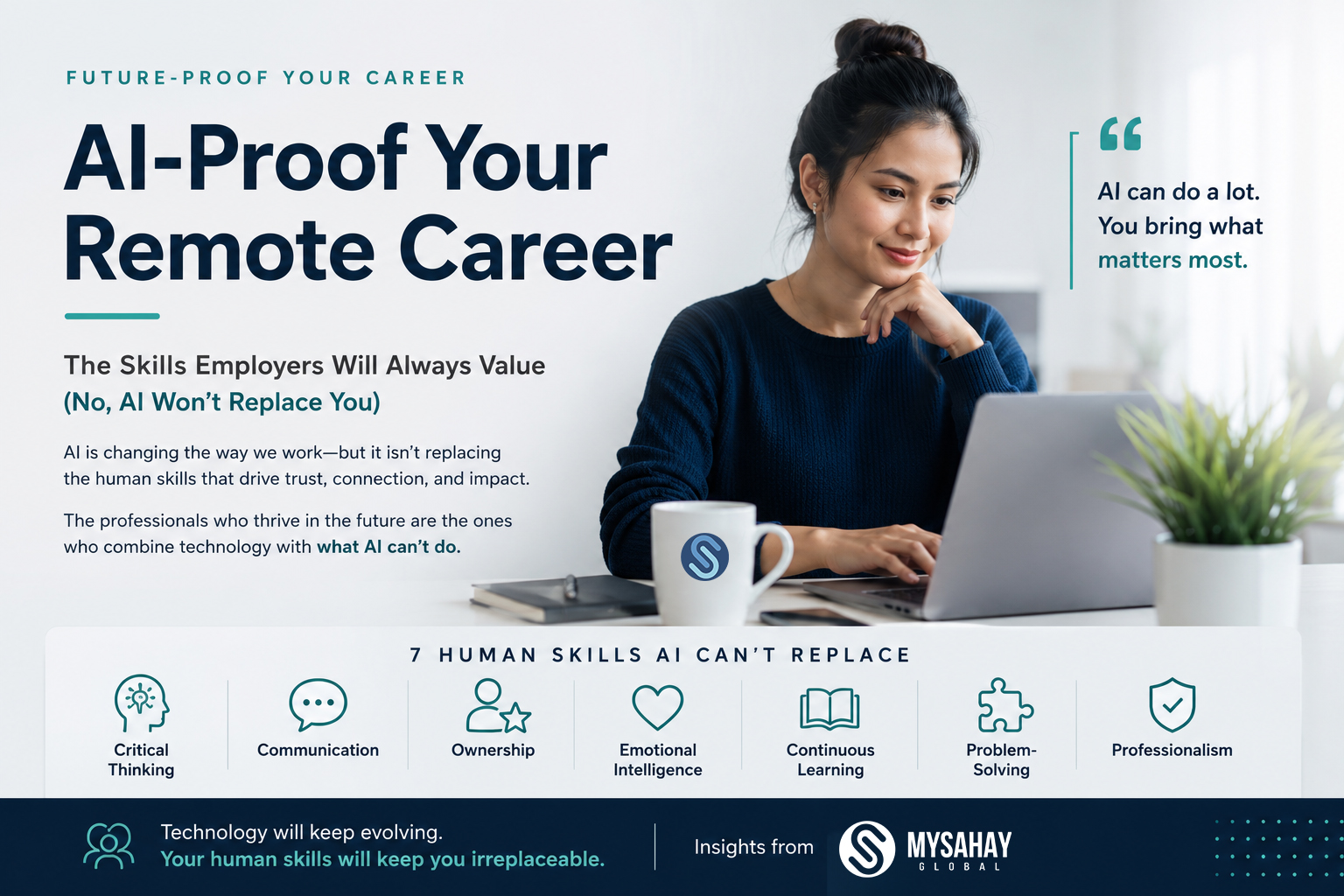
We’ve watched remote professionals succeed despite—or maybe because of—rapid technological change. They’re succeeding because they’ve developed seven specific capabilities that are genuinely difficult to automate.
The Skill: Questioning AI outputs instead of accepting them blindly.
AI generates answers at stunning speed. What it doesn’t do reliably is question whether those answers are actually correct within your specific context.
Strong professionals read what AI produced and think, “Wait. This doesn’t align with how our client works.” Or, “This would actually break our system.” Or even, “This is clever, but it’s solving the wrong problem.”
That awareness is human-level judgment, and it’s increasingly valuable.
The Skill: Clear, empathetic messaging in a world increasingly full of generic content.
This might sound counterintuitive. The more AI writes, the more organizations actually crave clear, human communication.
Think about how many impersonal, poorly-worded, AI-generated emails you’ve already received. Now imagine how refreshing a genuinely thoughtful message feels in that context.
A message where someone actually considered your perspective. Where they acknowledged your concern before explaining the solution. Where the tone matched the situation.
We’ve watched technically average professionals become irreplaceable because they could write an email that made a stressed client feel heard.
That’s not being automated away. That’s becoming more valuable.
The Skill: Noticing gaps and filling them without being asked.
There are professionals who wait for instructions. And there are professionals who notice problems and solve them proactively.
The second group gets ahead. Always.
You know what AI can’t do? Take ownership. It can execute tasks assigned to it. But it won’t notice a broken process and fix it. It won’t follow up on something without explicit instruction.
Humans can care. And organizations built on people who care consistently outperform organizations built on people just following orders.
The Skill: Building trust and psychological safety across distance and time zones.
Remote work requires something that still requires being human.
Recognizing that your colleague in Sydney is exhausted because they’ve been on calls since 6 AM. Sensing that your client is frustrated but trying not to show it. Knowing when to push forward and when to step back.
Those micro-moments of understanding build trust. Trust builds loyalty. Loyalty builds careers.
AI can analyze sentiment. It cannot genuinely feel another person’s frustration or joy. Remote professionals who excel at this become anchors—people want to work with them.
The Skill: Staying curious and adaptable as technology evolves.
The professionals thriving five years from now won’t be the ones with the longest resume.
They’ll be the ones who never stopped learning.
Technology changes. Always has. Always will. The people who stay curious—who genuinely like figuring out how things work—they adapt naturally. It’s not a grind. It’s who they are.
Curiosity ages better than any certification.
The Skill: Suggesting better approaches instead of just completing tasks.
Organizations don’t pay people to complete checklists. They pay people to make things easier. To spot inefficiencies and fix them. To suggest a different approach that saves time or money or frustration.
Sometimes that’s dramatic. More often, it’s just one colleague in a meeting saying quietly, “What if we tried this instead?”
That person gets noticed. That person gets promoted. That person becomes the one everyone wants on their team.
The Skill: Showing up prepared, meeting deadlines, and being reliable.
This might sound quaint. But professionalism separates people who have jobs from people who have careers.
Showing up prepared. Meeting deadlines. Respecting confidentiality. Communicating with respect. Being accountable when things go wrong (and they always do).
These aren’t flashy. But they’re the reason clients keep working with someone for years. They’re why managers fight to keep certain people on their team.
Professionalism is the thing nobody notices until it’s gone.
Stop asking: “Will AI take my job?”
Start asking: “What can I do that AI cannot easily do?”
The first question makes you defensive. Makes you protect old ways of working. Makes you anxious.
The second question makes you adaptable.
And adaptability has always been the actual career advantage.
Use AI Tools Strategically
Let it draft things. Let it organize information. Let it handle the repetitive stuff so you can focus on work that requires a human brain.
Then Bring What It Cannot Replicate
Your judgment. Your creativity. Your experience. Your integrity. That’s where the actual value lives.
Develop the Seven Skills
Pick one. Master it. Move to the next. This isn’t a sprint. It’s a progression.
Stay Curious
Read about new tools. Experiment. See what works. Ask questions. Learn from colleagues.
The workplace will keep changing. Remote work will evolve. AI will get smarter.
Organizations will still need people who can think critically, communicate clearly, solve problems, and grow long after the excitement around the latest technology fades.
That professional is not being automated away. That professional is becoming more valuable.
So don’t just survive the AI wave. Learn it. Use it. Get smarter because of it.
Then focus on becoming the kind of professional technology actually needs.
The question isn’t whether AI will replace you. The question is whether you’ll replace yesterday’s version of yourself.
Join the My Sahay Global Talent Community. We’re building careers designed to thrive in a world where AI is standard, not scary.