
Helping your business thrive
Contact Us
- 707 7F PITX Tower 2 Building, 1 Kennedy Road, Paranaque City
- info@sahaypro.com
- +63 (02) 5310-2455
Every job seeker has heard some version of the same advice.
Tailor your resume. Use keywords. Smile during the interview. Follow up within 24 hours.
None of that is wrong, exactly. But it’s also not the real answer to the question everyone’s actually asking:
“What do U.S. employers actually want from a remote professional?”
Not the version on the job posting. The real version. The one that decides who gets hired, who gets kept, and who gets let go after month two.
At My Sahay Global, we sit in a strange, useful position. We talk to U.S. employers every single day, the ones hiring healthcare admins, customer service specialists, project coordinators, executive assistants, marketing support. And we talk to the remote professionals on the other side of that relationship just as often.
So we hear both sides. The polished job description and the honest debrief three weeks later.
And here’s what we’ve noticed: the two rarely match.
Job descriptions are written by HR. They’re written in a hurry, usually by someone trying toc over every possible responsibility so nothing falls through the cracks later.
So you get postings stacked with requirements. Five years experience. Proficiency in six software platforms. A degree in a specific field. A laundry list that makes even qualified people hesitate before applying.
But ask the actual hiring manager (the person who’ll be in daily standups with this hire, who’ll feel the relief or the regret of that decision) what they really need, and the answer gets simpler. Almost disarmingly so.
They don’t lead with software skills. They lead with something else entirely.
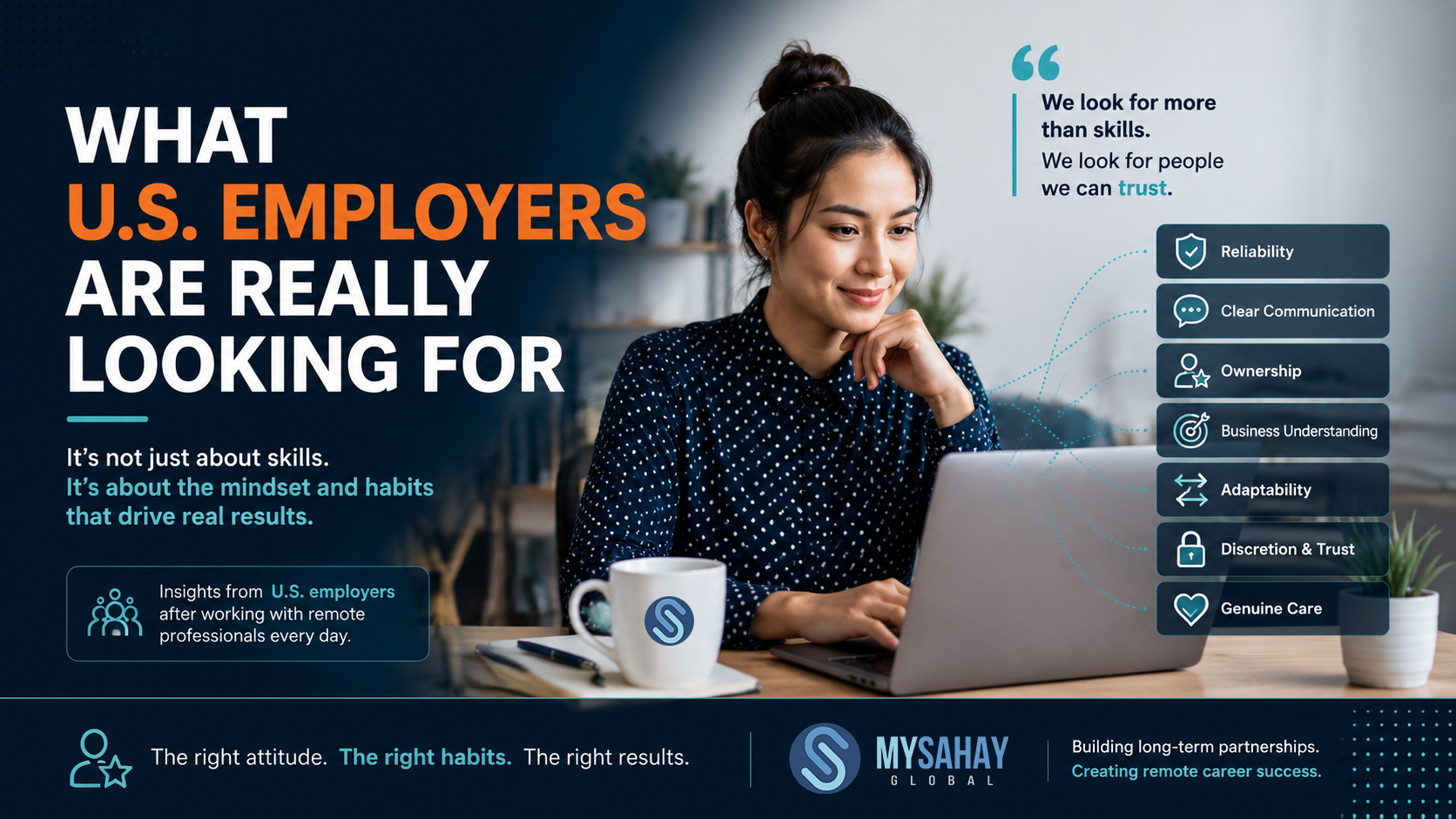
We’ve watched remote professionals succeed despite—or maybe because of—rapid technological change. They’re succeeding because they’ve developed seven specific capabilities that are genuinely difficult to automate.
The Reality: A brilliant professional who’s inconsistent is more stressful to manage than an average one who’s dependable.
We’ve heard this from client after client. Talent gets you the interview. Reliability gets youthe renewal.
U.S. employers, especially small and mid-sized businesses, aren’t just filling a seat. They’re trying to remove something from their plate permanently. If they have to wonder whether you’ll show up, whether the deadline will slip, whether they’ll need to double-check your work, the value of your talent quietly evaporates.
Showing up when you said you would is still, somehow, a competitive advantage.
The Reality: Employers aren’t looking for perfect grammar. They’re looking for clarity.
This one surprises people. English proficiency matters, sure. But what U.S. employers actually flag as a dealbreaker isn’t accent or phrasing. It’s silence. Or vagueness. Or messages that leave them more confused than before they asked the question.
They want to know
A professional who says, “I’m not sure I understood point two, can you clarify?” earns more trust than one who nods along and delivers something off-target three days later.
The Reality: Employers want to hire someone they can eventually stop managing.
This is the one that separates a good hire from a great one. Not “did the task get done,” but”did I have to ask twice.”
Employers running lean teams, which is most of them, don’t have bandwidth to micromanage. They need people who notice a gap and close it. Who see a recurring problem and flag it, or better yet, fix it, without waiting for permission.
The professionals who get promoted, given more responsibility, and trusted with bigger accounts are almost always the ones who stopped waiting to be told what to do.
The Reality: Employers can tell within weeks whether you’re just completing tasks oractually invested in outcomes.
There’s a real difference between someone who processes 40 patient intake forms because that’s the job, and someone who processes 40 forms and mentions that three of them had the same recurring error worth flagging to the clinic.
The first person is doing the job. The second person is starting to understand the business. Employers notice which one they have. And they build long-term plans around the second one.
The Reality: Priorities shift. Software changes. New tools get adopted overnight. Employers want people who bend, not break.
Nobody expects perfection when a new system rolls out. What employers are watching for is attitude. Does this person get curious and figure it out? Or does this person get defensive and resistant?
Remote professionals who treat change as a minor inconvenience, instead of a personal attack, become the ones employers lean on hardest during the messy, uncertain stretches every business goes through.
The Reality: Remote work often means access to sensitive information (patient records, financial data, client details) with far less oversight than an in-office role.
This is especially true in healthcare, legal, and finance, where a huge share of our placements happens. Employers are trusting someone they may never meet in person within formation that could seriously damage their business if mishandled.
Trust isn’t built through a signed NDA. It’s built through months of small, consistent proof that confidentiality actually means something to you.
The Reality: This is the hardest one to fake, and employers can always tell.
There’s a version of “doing the job” that stops exactly at the edge of the job description. And there’s a version where someone genuinely wants the client, the patient, the customer on the other end to have a good experience, not because it’s required, but because it matters to them.
U.S. employers, particularly in healthcare and client-facing roles, will tell you this is the single hardest trait to find. Skills can be trained. Software can be taught. Caring about the outcome is either there, or it isn’t.
Notice something about all seven of these?
None of them are about a specific software platform. None of them require a particular degree. None of them show up cleanly on a resume.
They show up in how someone communicates on day three of a rough week. In whether a deadline gets flagged early or explained away late. In the small, unglamorous decision to double-check something instead of assuming it’s fine.
U.S. employers aren’t primarily hiring skill sets. They’re hiring judgment, consistency,and character, and hoping the skills come along with it.
If you’re building a remote career, this is genuinely good news.
It means you don’t need to be the most credentialed applicant in the pile. You need to be the most trustworthy one. The one who does what they said they’d do. The one who communicates like an adult having a real conversation, not a chatbot generating updates.
That’s learnable. That’s buildable. And unlike a specific software certification, it doesn’texpire.
This is exactly why we built My Sahay Global the way we did.
We don’t just match resumes to job descriptions and call it done. We spend real time understanding what a U.S. employer actually needs, not just what’s written in the posting, and we look for professionals who show these seven traits before we ever put them in front of a client.
Then we don’t disappear after placement. We stay in the relationship, supporting both sides, because a placement that lasts three weeks doesn’t help anyone. A partnership that lasts years does.
That’s the difference between filling a role and building a career.
Join the My Sahay Global Talent Community. We connect skilled, reliable Filipinoprofessionals with U.S. employers who value more than just a resume, and we stay with youevery step of the way.